Wednesday, September 18, 2013


What Does the Fox Say? Top Ten Ideas From City Fox

Chances are by now you’ve seen the video ‘What Does the Fox Say?’ The Ylvis brothers developed a catchy music video starting in Norway and spreading like a wild fire across the planet, jumping from city to city. In less than a week 15 million people watched the fox dance and try to make his case.

Videos and other social media are emerging as one of the most powerful forces shaping countries and cities. For example, Oscar Morales and his Facebook campaign to ban FARC in Colombia, the Arab Spring, and Toronto’s recent police shootings and earlier G20 beatings (video taped and shared widely – police charged and convicted).
 

Sunday, September 15, 2013


Why a City’s Not a Duck


Ducks in a row

Up north on the lake, every year near our cabin, we see a pair of nesting ducks. We call her Mrs. Merganser as she leads her 8 to 16 ducklings around the lake. There’s a Mr. Merganser too, but truth be told, he seems a bit of a slacker in the childcare department.
The ducks make an annual migration of a few thousand kilometers, splitting their time between the northern lake, southern retreat, and a couple months on the road. The birds are transient.

The Old Man is Snoring

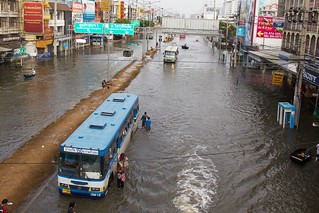
Flooding in Bangkok
‘It’s raining, it’s pouring. The old man is snoring.’ Truth be told, I apparently snore, and I suppose I’m not that young anymore. But hard to believe, I’m sure this nursery rhyme is not about me. And despite the recent Noah-like floods in Europe, Bangkok, Calgary, Dhaka, Jakarta, New York and Toronto, it’s not really about any one city, or any one country, or even any one continent. But, ‘went to bed and bumped his head. And won’t get up in the morning,’ aptly describes our current political paralysis.
Many children know this song. Soon they will learn how their grandfathers and fathers slept through the rain.

Monday, July 15, 2013

Why Running a City is Like Paddling a Canoe

 
 Canadians are supposed to be good in a few things: skating, painting trees and rocks, welcoming newcomers, writing engaging stories that surely must have a meaning in there somewhere, and paddling a canoe. The canoe—a bit like the moose—holds an almost mythic place in the Canadian psyche. Anything and everything can be compared to canoeing. This metaphor is apt when applied to city administration.

Wednesday, May 1, 2013


Urban Careers and the Twenty-Ninth Day

Lily pads on lakeA helpful way for young math students to grasp the concept of exponential growth is to look at water lilies growing on a pond. They grow exponentially and double in area each day. If they will fully cover the pond by the 30th day, on what day is the lake half covered? The twenty-ninth day[1].

This year I had the honor of teaching 4th year energy systems students who will graduate later this month (their blogs on energy issues will be presented on this site over the summer). These graduates are particularly essential. During their careers they will be part of the world’s largest ever city-building spree. Their task will be to again double the world’s cities.

Saturday, April 13, 2013


The Buzz of Cities

BeeFor bees, bigger hives are better. 

Last week researchers at the University of Arizona published their findings: bees of bigger hives have more information and forage better. With improved communications, bees from the bigger hives sent new foragers to known resources up to four hours earlier than bees from smaller hives.1

This better communications also seems to work in bigger cities. Geoffrey West and the SantĂ© Fe Institute provide impressive modeling on the scaling of cities. Double the size of a city and you get 1.15 times the growth of economy, patents and innovation. And as long as you can keep congestion and pollution in check, you can get this economic growth at only 0.85 times the cost of additional infrastructure. In other words, larger cities have a disproportionate impact on a country’s communications, and therefore a bigger impact on economy and culture.

Friday, February 15, 2013


One Fish, Two Fish, Red Fish, Blue Fish*

Blasty Fish, Dr. Seuss‘From there to here, from here to there, funny things are everywhere!’
That one blue fish cost a million plus,1 that one blue fish and all the fuss.

In cities here and cities there, you’d think by now we’d be aware.
That we’d take some care for what is rare. But here’s another to make you stare:

Soup can come with a shark’s fin; yes, so strange a fin that’s mixed right in.2
So much money is being spent, just how far can we go, and to what extent?

‘Say! What a lot of fish there are.’ Yet there they go near and far.
Tuna, sharks and even rhinos too; all sold in a city near you.

Save a fish, save a tiger, save an elephant or two. Here’s what a kid could do
Shout ‘Oh Mr. Mayor in that great big chair, is your city doing its fair share?’

Presidents, queens and kings. Treaties, conferences and other hopeful things.
Hunters, fishers, angry warring foes, and even NGOs.

From here to there, all of them can save that fish, and can keep it from the dish,
But none of them, yes, it’s true. Mr. Mayor none of them, as well as you.

From there to here, from here to there, boys and girls are everywhere
Please save our fish; it’s a simple wish. One fish, two fish, few fish, blue fish.

Wednesday, February 6, 2013


Hey Cities, Slow Down

‘Lord give me patience, but please hurry.’1Everyone working with cities has probably felt this sentiment. We see the new buildings, read the reports, and know that the hurly burley rush to urbanize across the world is picking up speed – we are about to repeat the amount of city-building we did in the last 200 years, but this time we will do it in just 40 years. Surely we have no time to slow down.

Chaucer said it well in Canterbury Tales, ‘In wicked haste is not profit.’ Or as in the sage Chinese proverb, ‘A hasty man drinks his tea with a fork.’ Haste makes waste. In the rush to urbanize, we are in danger of wasting many opportunities within our cities, as we lock in little foibles and big mistakes.

Monday, February 4, 2013


Controversy Continues to Hound Groundhog Day Celebrations

Punxsutawney Phil, Groundhog's DayPunxsutawney, Pennsylvania: Saturday around 7:00 am, Punxsutawney Phil (PA, USA) emerged from his burrow, did not see his shadow and predicted an early end to winter. A few minutes later and a few hundred miles north, Wiarton Willie (ON, Canada) surfaced, didn’t see his (or is it her) shadow and also predicted an early spring.

Once again, like last year, immediately after the groundhogs issued their prognostications, the Houston and Calgary based ‘Committee for Climate Certainty’ rebutted the groundhogs’ findings, claiming the science was uncertain. The Committee released several years of hacked emails between Wiarton Willie and Punxsutawney Phil – “What are we going to do about those climate doubter’s concerns? We are likely to have a repeat of last year.” Willie is purported to have written Phil in an email. “Let’s stick to the date, fudge the timing, and hope no one notices,” Phil is reported to have responded.

Friday, January 18, 2013


Snakes and Dragons in the Year of the Mayor

Year of the Snake graphicFirst the good news: Earlier this month, Mayor Iñaki Azkuna of Bilbao, Spain was awarded the prestigious World Mayor Prize for 2012. Mayor Azkuna was in good company. Other finalists included the mayors of: Perth, Australia; Surakarta, Indonesia; El Paso, USA; Changwon City, Korea; Auckland, NZ; Angeles City, Philippines; Zeralda, Algeria; Matamoras, Mexico; and somewhat surprisingly, Mayor Regis Lebeaume of Quebec City, Canada.

The bad news for 2012 and mayors was best seen in Canada. The World Mayor Prize shortlisting of Mayor Lebeaume came amidst a spate of problems for other mayors in the Province of Quebec. At least four mayors resigned over corruption allegations in Quebec, including Montreal’s Mayor Gerald Tremblay.

Canada’s embattled mayors were not limited to Quebec. Mayor Ford of Toronto was found guilty of conflict of interest and now fights to keep his job. Controversy also swirled about the mayors of London and Mississauga, ON; Winnipeg, MB; Halifax, NS; and Tofino, BC.

Monday, January 7, 2013


You can check out any time you like, But you can never leave

World Bank, Washington, DCAs of January 1st, I’m officially ‘retired’ from the World Bank. This is a dozen years before I had to retire, but I wanted to move back to Ontario for love and opportunity. However, I’ve already come to the conclusion that if you care about sustainable development and cities, you can never fully leave the World Bank.

Things are about to get ‘very hairy’ as we bump up against, and in a few cases pass right through, planetary limits. Sure, sure – everyone’s familiar with the rebuttals to the ‘limits to growth’ argument, and true, humans are amazingly resourceful. We will certainly pull a few innovative planetary rabbits from our hat. But make no mistake, tomorrow’s world will be much more affluent, uncertain, less stable, and at times, down-right scary as we deal with a billion-plus people that expect to live a similar lifestyle to today’s fortunate few (the planet’s richest two billion are being joined by another two billion ‘middle class’). All this is happening while we still have more than a billion people living in absolute and debilitating poverty (the single largest source of instability in the world).

Wednesday, January 2, 2013


Cities: The Gift that Keeps on Giving

Giftwrapped building in AmsterdamJesus and Muhammad traveled to the wilderness to develop their teachings. Even Gautama Buddha is said to have sat quietly beneath the rural Bohdi tree while he waited for enlightenment. But once they knew what needed to be said, all three men travelled to the closest city to convey the message.

It may take a village to raise a child, but it takes a city to change the world. Jesus, Muhammad, Buddha, and influential mortals like Abraham Lincoln, Nelson Mandela, Winston Churchill, Eva Peron, Marie Antoinette, Chairman Mao; they all gave their impassioned speeches, teachings, and at-times arm-twisting arguments, in cities. Cities are where the spokespeople for civilization come to urge the rest of us to follow a new path.

Tuesday, December 18, 2012


Cities Now On the Third Wave

Breaking waveAround 5000 years ago, the first cities emerged in Mesopotamia and the fertile valleys of the Tigris and Euphrates Rivers. Agricultural surpluses enabled a few people to start specializing in something other than agriculture. The farmer who now had extra grain could trade for a better spear or a winter fur coat. This specialization and the ability to trade goods and services is the basis of urbanization. And, there was enough food that the starving artist didn’t starve completely, so along with trade, culture emerged.

Cities grew at a modest pace until about 1800 when the Industrial Revolution took off in the UK and cities developed at staggering rates. Manchester, for example experienced a six-fold population increase from 1771 to 1831. London went from about one-fifth of Britain’s population at the start of the 19th Century to about half the country’s population in 1851. This rate of urbanization has not let up for the last two hundred years; in fact it is still accelerating. The growth of cities seen over the last two hundred years will now be repeated, but this time in just forty years.

Wednesday, November 28, 2012


                    Why a City’s Not a Country

Flags in front of UN headquarters, New York City
UN Headquarters, New York, NY

We all have the currency of a country or two in our wallets; maybe a passport too. We can be brought to tears when we see ‘our’ flag unfurled at the Olympics or a World Cup. Sure there are great sporting rivalries between cities like Milan and Barcelona, Sao Paulo and Rio de Janeiro, and (in that other football) Dallas vs. Washington. But it’s countries that need flags and currencies, languages and laws, to inspire passion and fidelity. Running a country is about protecting an idea, an ideal, and a dream. Psychologically and physically countries have borders – barriers to entry and exit; people, ideas, money – it all needs to be controlled by a national authority.

Cities are different. Cities are anchored to a specific place. A sheltered port, the mouth of a river, a fertile valley, or a strategic vantage point: cities emerge where geography and opportunity combine. Much has been written on the creative class – that fickle, mobile group of professionals wandering the planet looking for their next engagement. City officials may actively seek them, but far more important are those people willing to stay and fight for their city. With links and roots like children, mortgages, and history, people who feel they belong are the foundation of every city.

Wednesday, November 21, 2012

Cities and Their Underwear

 
BoxersThe next time you're in a new city, maybe jet-lagged, try to wake-up early and take a walk: The earlier the better. Watch as the city wakes, the merchants restock their shelves and workers take away the waste. Street sweepers and garbage collectors take advantage of the quiet streets; people open offices and stores; the calm before the rush. Perhaps your hotel is near a market – check out how early the bakers and farmers start working. A few newspapers are still delivered before the sun rises.

While walking and watching the city wake, also look beneath your feet. There the pipes deliver water and gas; sewers take away wastewater. And if you’re in Europe most of the electricity is delivered through underground piping as well (strange how cities in the US and Canada, where hurricanes are common, have most power lines above ground, while Europe, with fewer storms but more concern for aesthetics, have most power lines buried).

Tuesday, November 13, 2012


The Utilities of Cities

Operations Center, Rio de JaneiroThe care and feeding of cities is likely the world’s largest business; it’s certainly one of the fastest growing. With an additional 2.5 billion people headed to cities in the next 30 years, providing these ‘customers’ with energy, water, transportation and waste management is critical for local government, as well as a huge opportunity for the private sector. Utilities are big business.

The next five to ten years will see enormous change in the utility sector. How services are combined – does it make sense to have the same utility supply communications infrastructure along with electricity, gas and lights and water supply? How much of a ‘foreign’ company will be allowed to provide local services? What is the best mix of public private partnerships? How will improved efficiencies be measured and rewarded contractually? How can ICT be used more effectively in improved service delivery in the more basic services like water, waste and district heating? How do utilities facilitate services to the urban poor?

Thursday, October 18, 2012


Breaking Up Is Hard To Do

In 1967 Montreal hosted the World Expo in a massive 100-year old birthday party for Canada. Festivities were grand and the future seemed bright, but a slow decline had already set in. The Montreal Olympics of 1976 were also not enough to offset the forces of Quebec separatism. From a full third of Canada’s population in 1951 to less than one-quarter in 2011, Quebec’s separatist aspirations have had an economic cost on the Province, especially on the city of Montreal. Montreal is certainly still a great city, but the odds of it ever again becoming Canada’s financial center or largest city are remote, especially after last month’s election victory by the Quebec Sovereigntist party.

Saturday, October 13, 2012


A Crystal Clear Business Case for Cities

The new Siemens Crystal, the world’s first center dedicated to improving our knowledge of urban sustainability
The next time you’re in London be sure to visit the new Siemens Crystal. The Crystal opened to fanfare and urban guru accolades a couple weeks ago. The 30 million pound, 6000 square meters building is on the east bank of the Thames (a short walk from the Royal Victoria DLR stop). The building is divided into two parts, an exhibition and meeting place on cities and headquarters for up to 100 London-based Siemens staff working in the urban sector and external cities experts. Siemens has plans to build similar, albeit smaller, competence centers for cities in Washington, DC and Shanghai.

When wandering through the majestic building, one might wonder why Siemens would spend so much money on what is arguably mostly a public meeting place on cities. Similar to any successful company, Siemens is driven by profits. Making a business case for public education is likely not always easy, even if your company would benefit more than most from a better informed public. But a well-informed public asks many questions, some which might be uncomfortable.

Boys and their Toys – Building Better Cities

Niagra Falls, North America
Caution – this blog is almost as long as the soon-to-be commissioned Niagara Tunnel.

Often I can hide it – posing maybe as an economist, risk manager, a finance-guy, public-policy wonk; I’ve even once been complimented as an urban planner. But every now and then I revert to form and it slips out that I’m an engineer. This week was a classic – a ‘boy and his toys,’ my wife warned.

I went to Niagara Falls not to see the falls, or visit the casino, but to tour Ontario Power Generation’s (OPG) Niagara Tunnel and Adam Beck Hydroelectric Power Station! Well worth a ‘!’ as getting to visit these two big civil engineering works was a bit like Christmas coming early; and they provide important lessons.
The trip was particularly poignant for me for two reasons. First getting to see these huge – and hugely important – pieces of urban infrastructure up close is an amazing opportunity. These projects make up the bones and plumbing of corpus urbanus. Second, these two massive civil works underpin Niagara Falls. It’s a location that is likely the best place in the world to see sustainable development in action – the good, the bad, the historic, and increasingly the hopeful.

Sunday, September 30, 2012


The End of Men: And the Peril of Cities

Men at Work signThere’s been lots of talk lately on Hanna Rosin’s new book, ‘The End of Men: And the Rise of Women.” In it she outlines the long decline of ‘cardboard’ men and the steady rise of ‘plastic’ and adaptable women.

In the US, for example, for every two men who will get a bachelor’s degree this year, three women will graduate. In 1950, 1-in-20 men in their prime were not working; today it’s 1-in-5. A young black man in the US has roughly an equal chance of ending up in prison or college. In almost all countries young men are 2 to 3 times more likely to commit suicide than women, and in many countries suicide is the second leading cause of death for young men; second only to accidental deaths1.

The recent economic slow-down has been disproportionately hard on men around the world, and of the 15 job categories expected to grow fastest in the future, women mainly staff 132.